Love Your Waters
Jun 09, 2026
I have a client who came in with shoulder pain. She said it’s getting unbearable. We’ve gotten her from a pain scale of 7 to a 2. Her shoulder pain is not just in her shoulder; it is a culmination of the posture and tension throughout her body that she has been carrying for the entirety of her life.
She has a lump on the bottom of her foot. She has had surgery on it, and it didn’t take the lump or the pain away. She leans away from the pain to the left side and does not evenly distribute her weight in her feet. Her spine deviated in a zig and a zag. Her pelvis was high by at least 1.5 inches on her right side when she arrived. Her head is cocked to one side, her ribs are collapsed on one side. There is a zigzag pattern that runs through her body, and yes, she has scoliosis. I see scoliosis in different degrees of severity quite frequently in my practice.
Spinal compression and pinched nerves are a result of fascial restriction. Fascial restriction can be released with MFR. I treat my clients with Myofascial Release exclusively because it delivers the best results. If you want to get out of pain, find greater ease and mobility, you need to release your fascial restrictions.
I went to a lecture last Saturday with Gil Hedley PhD. He was doing a nerve tour. He has been a Rolfer, a structural integrator, and he unveiled groundbreaking research and discoveries from his dissection lab, showcasing the extraordinary nature of the brain and spinal cord. He calls himself an integral anatomist. He is a poet, a philosopher of sorts, and I could relate deeply with him.
In his messages, as he showed us slides of the three subjects that he dissected, he had such a beautiful reverence for all of the people who had made his research possible, including the lives of the people who had left their bodies and donated their bodies as cadavers. He dissected his subjects and uncovered their nerve trees. He had such detailed anatomy of the nerve branches, and he showed us so many of the nuances and complexities of these human bodies as he followed and uncovered meticulously the branches of the nervous system.
What I learned from Gil is that each body’s nervous system is in a different location. That a diagram of the human body is a map, and that the actual landscape of each person’s body is different from one another, yet similar. The anatomical structure of a body on a diagram is an average, taken from many different bodies. It is “about” where things are; it is not an exact science. He referred to this often and emphasized how important it is to be present with what is in front of you, and with who is there presenting with their unique individualized body.
What is constant is change. We are always growing, changing, shifting. Nothing in the living is static.
He showed slides of the layers inside of the skull and the heart’s vascularization of the brain, and spoke poetically on how our heart and brain are inseparable. As humans, we separate things in our minds so that we can focus on one thing, and in fact nothing is separate. We are all interconnected and interrelated, especially inside of our body.
As we poured through the five hours of anatomy, it was thick. There were so many things to learn and know, and so much that I knew and was familiar with. What I love is that I went to a school where I learned Latin at a young age. That has come in handy in my profession; the language of anatomy is Latin. Latin words have roots, and so do nerves.
Nerves are wrapped together with arteries and veins; they are all interwoven together, spiraling with each other. Some nerves branch out and then come back together, some are embedded within muscles, adipose tissue, fascial sheaths, tendons, and ligaments. These pathways in each person are different.
It makes me question the accuracy when doctors have a blanket understanding and do not see an individual and take time to listen and observe. The allopathic linear approach is lacking because there is not enough attention to the specific details that lie in physical structure and tissue of the unique individual.
Gil used the example of losing your keys. Have you ever lost your keys, he said. He then talked about the left and right hemispheres of the brain and cognitive versus creative function. He likened logical critical thinking of the left brain to looking through a 6-foot straw. The left brain needs to focus so it actually erases the thoughts, memories, and function of the right brain—the creative, contextual, intuitive side.
So when you are hyper-focused, you can actually miss your keys right in front of your face. So when you lose your keys, go out, put your feet in the grass or the ground, maybe soon the snow haha. Take a few deep breaths and relax. The right brain can see things better, and includes the mind but is not limited by it. Stay open, stay relaxed; everything works better this way.
In my practice I focus on the presentation of my client. I look to see what is holding back, what is rotated, bending, tight, crunched, collapsed—how the fabric of the tissue is arranged and organized, and what is disorganized. I take note of each lump and bump, each bony prominence, where the belly button is pointed, the taut and loose tissue, the curve of the spine, the height of the hips, the position of the pelvis, the flexibility of the ankles, the knees’ position, and importantly the relationships between the segments and individual parts.
I get close and then I step further away. I read the body for symmetry and organization, tone, size, and shape. I consider myself a sculptor and an artist. I listen, stay present, and observe. I notice and listen deeply to see beyond all the lines to where center is, and the holding patterns that may be blocking potential harmony within the body.
When I body read, I can see how I can bring the body back into alignment so the different segments are not fighting with each other. There is often torsion, where twists tend to spiral the body further out of alignment. To unwind tension requires finesse. You can’t push too hard or the body will resist and fight back. It is a deep play of listening, and this is where we adopt flow state.
When I talk about water with my clients, I find them instantly more fluid in their breath and presence. Because we ourselves are water. This water bathes our cells, permeates membranes, structural barriers of the cell wall, organs, muscles, and circulatory system.
The fluid in this space is called interstitial fluid, comprised of water and solutes. The interstitial compartment is composed of connective and supporting tissues within the body, called the extracellular matrix. The role of the interstitium in solute concentration, protein transport, and hydrostatic pressure impacts human pathology and physiological responses such as edema, inflammation, and shock.
So we are made of vestibules, tubercle matrix formations, and structures that create different patterns of the fascial web of our connective tissues, and information is passed between these membranes in fluid exchange.
We want the fascial layers and the interstitium to be in connection and flow, communicating and juicy, hydrated, pliable, flexible, and fluid. We want the synovial fluid within the joints to be able to spring-load and bounce to carry load with lightness. We want our nerve tree to be exchanging information between brain and body that sends out pleasure and inspires creativity.
There is so much research about the resonant heart, the vibrational frequencies of sound upon the waters and lands of our tissues. The art is inside of our bodies, in each ripple and fold of ourselves.
I have a client I have been seeing; she just had her seventh treatment. She came into my office barely able to walk, scream crying as she hobbled in bent over in agony and severe pain. She has worn holes in her shirt where she has grabbed her back right where she hunched over in kyphosis. She has been angry and upset, devastated at the loss of both of her daughters. These traumatic events in her life have been overwhelming.
She was convinced that she would be in pain forever. She has also been extremely hard on herself, and the only relief she would find is in bed, so that’s where she has been for 2 years. I have been working on her and the results are why I do what I do.
She is now inches taller. She comes in with a smile on her face. She is having days where she is not in pain. She is sitting up straight. She is learning how to handle the extreme circumstances life has dealt her.
Most importantly she is noticing how she has been beating herself up, and she is learning to curb this. She is learning to love herself and to breathe through her pain. She is healing, she is walking upright. We are working on her gait. She is remembering when she used to dance. She is learning how to move with more grace with each visit.
She is learning how to end the pain cycle and be open to the possibilities of a bright future. She hugs me and thanks me every time I see her for helping her get her life back.
There is still some pain, but the difference is noticeable. Her level of pain is becoming more manageable, and she is getting up to do chores. She is learning how to sit up tall and be present in her body. She is getting back to life and offering herself the love she deserves.
I am so grateful for her; she is my teacher. She has taught my inner voices to center in wisdom and, like good parents, to talk kindly to myself.
We need to love ourselves, even when we are hurt and dysfunctional. We need love. 100 out of 100 babies die if they are not touched after birth. Our skin and connective tissue need to be touched, held, loved, and soothed. We need pressure, hugs, we need to be held.
We need love.
Love is the answer to every question.
Make sure to be gentle, patient, and kind to yourself and every part of you, because you are a miracle. This life is a beautiful gift, and we are alive now. This is the time to fully live.
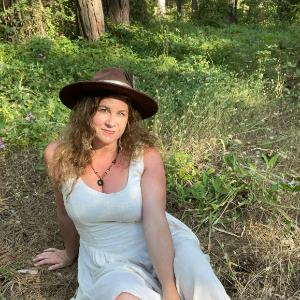
I am a Myofascial Release Therapist and an Injury Specialist. I help people get out of chronic pain patterns and back to doing what they love.
Angela Rose works at Sol Bodyworks in Grass Valley.
Author